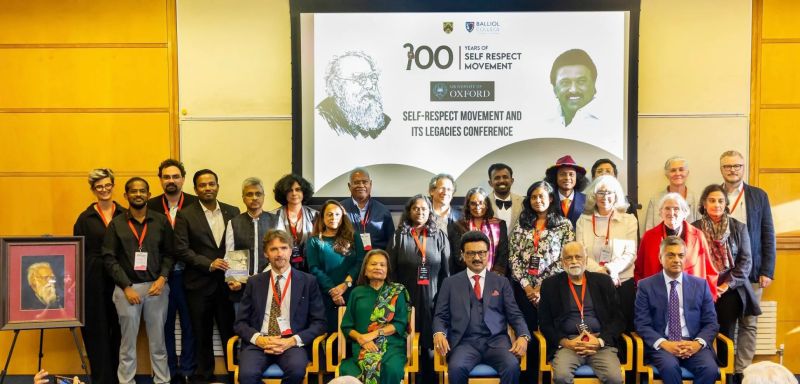
Earlier this week, I had the immense privilege of attending The Self-Respect Movement and its Legacies conference at Oxford. The event was nothing short of historic, graced by the presence of Tamil Nadu Chief Minister, M.K. Stalin, who unveiled a portrait of Periyar E.V. Ramasamy, a towering institution—an uncompromising voice that continues to resonate even a century after the birth of the Self-Respect Movement.
To call the conference an “intellectual treat” would be a vast understatement. The gathering brought together an extraordinary set of scholars and thinkers whose work collectively illuminates the historical depth, contemporary urgency, and enduring relevance of Periyar’s thought.
Paper presentations by A.R. Venkatachalapathy, S. Anandhi, Sumathi Ramaswamy, Christophe Jaffrelot, Karthick Ram Manoharan, Francis Cody, Abhimanyu Arni, Ganeshwar, and many others spanned historical, theoretical, and practical terrains—probing, questioning, and ultimately opening up provocative new lines of inquiry into what Periyar means for the world today.
The keynote address by Arjun Appadurai was a particular highlight. Brilliantly delivered, it served both as a fitting conclusion to the conference and, at the same time, as an opening salvo of fresh questions. His reflections will no doubt inspire future scholarship, ensuring that the debates ignited at Oxford continue to prompt important conversations across disciplines and geographies.
The event also marked a milestone for what can now fittingly – if somewhat provocatively, but still in true Periyar fashion – be called the field of Periyar studies. Two important books were launched: Vignesh Rajahmani’s The Dravidian Pathway and The Cambridge Companion to Periyar, edited by Chalapathy and Karthick Ram Manoharan. The latter volume brings together a wide range of essays—including my own contribution, which situates Periyar within a transnational framework, exploring his global relevance and impact.
For me, this conference stands out as one of the most enriching and personally fulfilling academic experiences in recent times. It was a rare moment where scholarship, politics, and memory converged in a deeply meaningful way. My heartfelt thanks go to Faisal Devji and Jim Mallinson for their vision and effort in making this possible.
Walking away from Oxford, I couldn’t help but feel that Periyar’s radical imagination continues to unsettle, challenge, and inspire us—and that the conversations sparked here will echo far into the future.
 Darinee Alagirisamy
Leave a comment